So what’s an anime fan's worst nightmare?
Easy question to answer: Waiting. Weeks and weeks of waiting.
Picture this scenario: It's Sunday morning. You wake up hyped because the latest, ground-shaking episode of Jujutsu Kaisen or Demon Slayer just dropped. The entire anime community on X, Reddit, and TikTok is already buzzing with spoilers, reactions, and memes.
You rush to your screen, only to hit a brick wall: the episode is in raw Japanese with incomplete English subs. And the French version (VF) or local subtitles? Forget about it for the next three to four weeks!
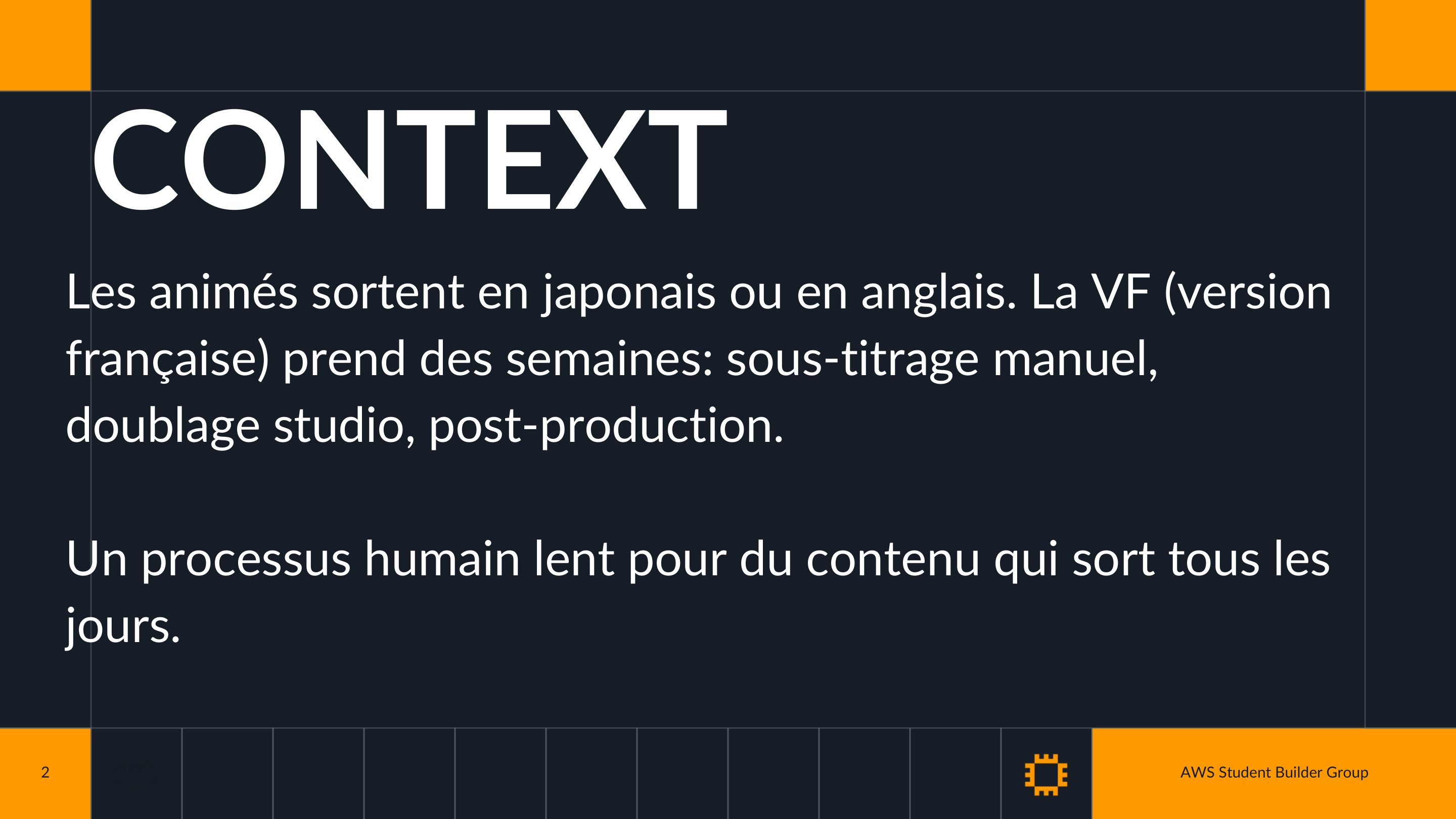
As illustrated above, traditional localization is a deeply human, slow process: manual transcription, script adaptation, voice actor scheduling in sound studios, and post-production mixing[1]. It works, but it simply cannot keep up with an industry that broadcasts new episodes every single day.

Quel supplice d'attendre, n'est-ce pas? 😭
A slow human process for content that releases every single day creates an undeniable accessibility gap.
On a Serious Note: Why Accessibility Matters
Beyond our impatience as anime enthusiasts, there is a much bigger conversation here about inclusion, language sovereignty, and technological access.
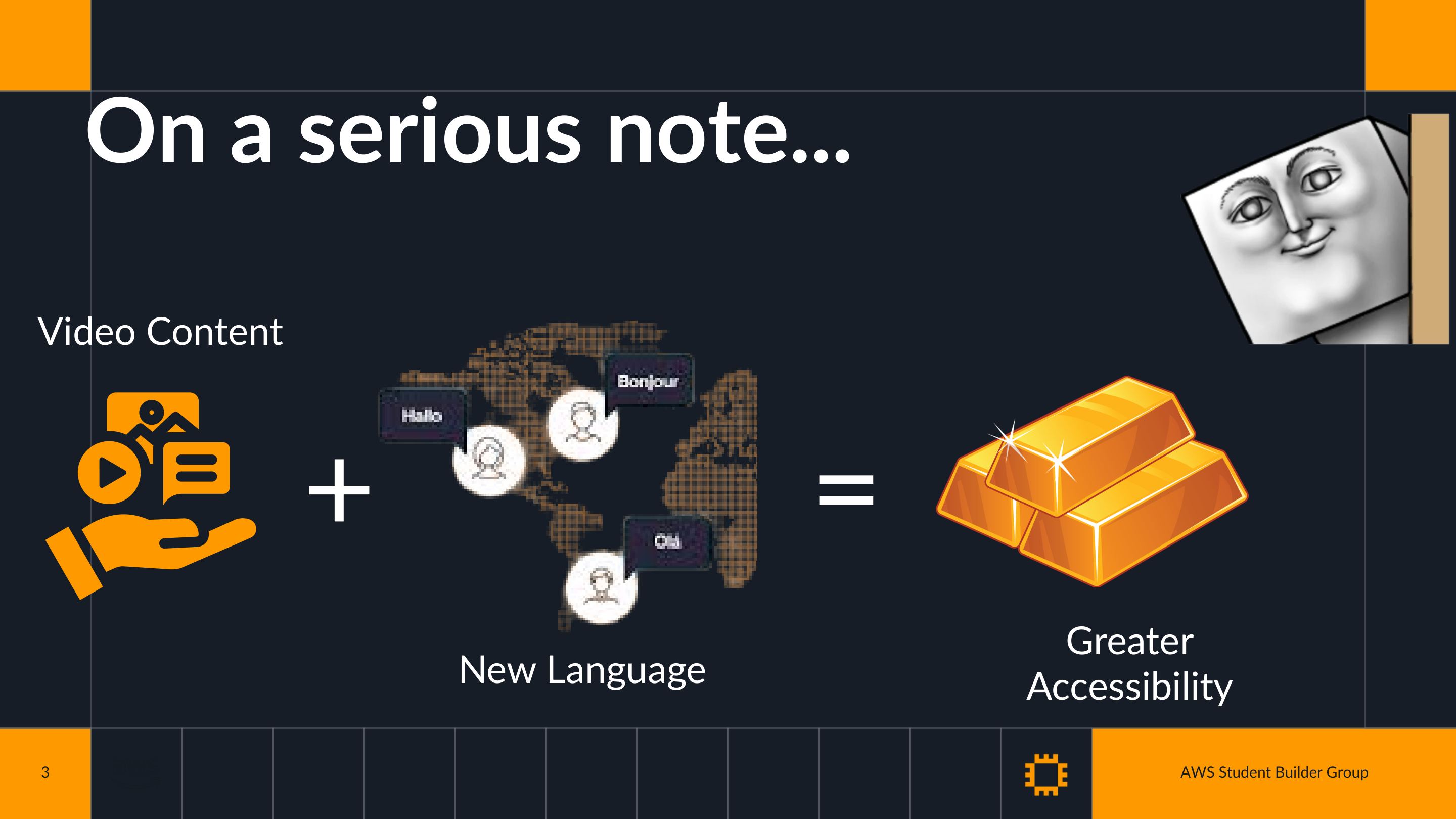
The mathematical equation is delightfully simple:
Video Content + New Language = Greater Accessibility
When you liberate a piece of media from language lock-in, you open the door to millions of viewers who were previously excluded from the global cultural conversation.
And now, ask yourself this bold question:
What if you could watch Jujutsu Kaisen, Naruto, or Attack on Titan in Ewondo, Bassa, or Ghomala[2]??
Why should technological advancements only serve English, Japanese, and French? If we can engineer a modular, scalable translation and dubbing pipeline, we can adapt it to any language on earth.
The Challenge: Studio Quality for ~$0 per Episode
So how do we circumvent this bottleneck, stay fully within legal research boundaries, and get our episodes ready on time without renting a multi-thousand-dollar studio?
Answer: We leverage the power of Serverless Cloud & AI on AWS!
And the sweetest part? ~0 $ per episode during exploration and development. Subarashi!
How is that possible? By building an event-driven serverless architecture where compute and AI models only run when a new episode file arrives. Zero idle server costs, zero baseline maintenance, taking full advantage of the AWS Free Tier[3].
Alright, we know what we want:
- The Input: An original episode video file (
.mp4or.mkv) in Japanese or English. - The Output: Synchronized French (or local African language) subtitles (
.srt) and a synthesized speech voiceover track (.mp3).
So... what is the first brick in this foundation?
First, Let’s Thank This One... Man: FFmpeg
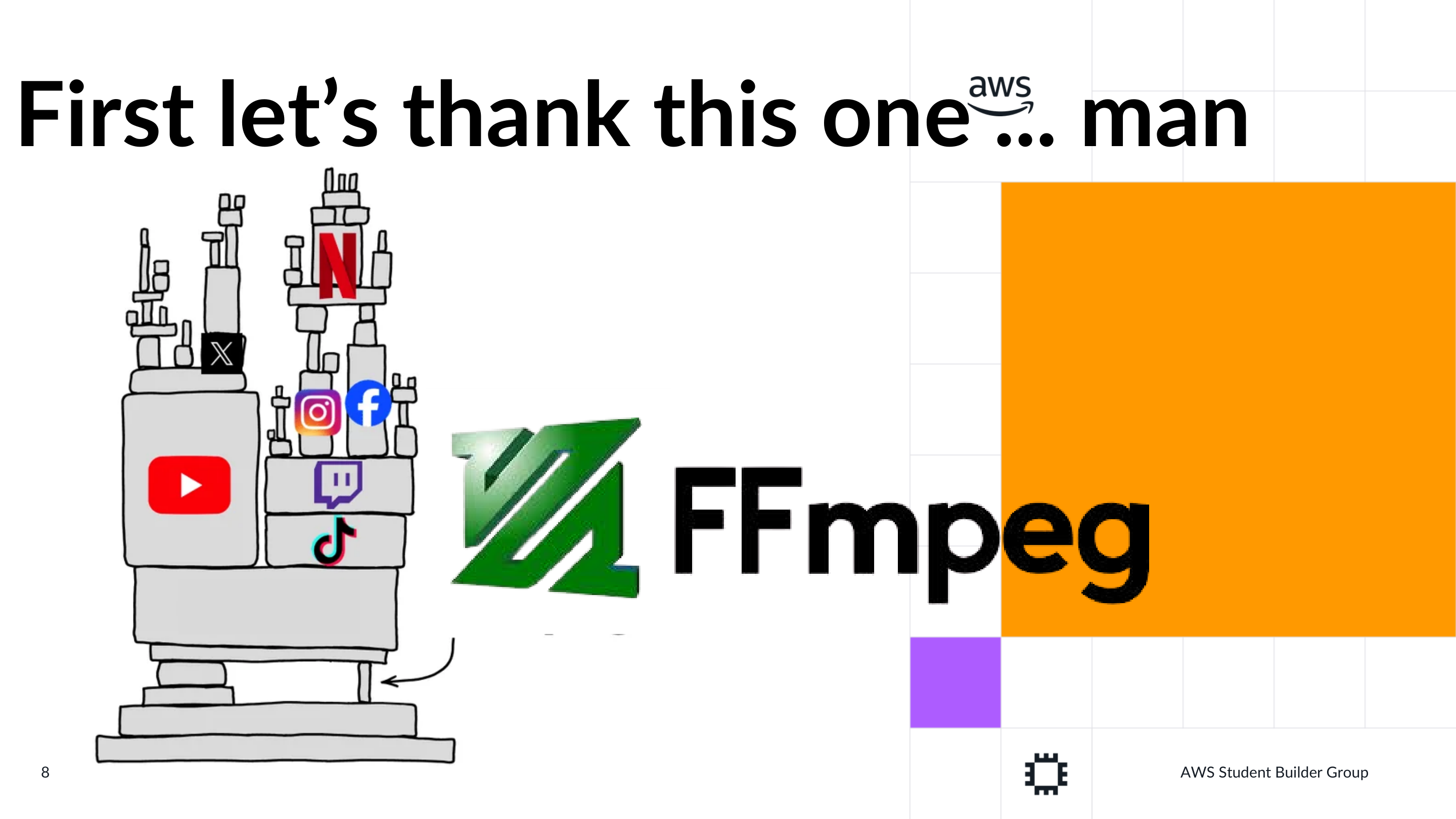
Before any artificial intelligence model can analyze a single sound wave, we have to strip the audio out of the video container. And whenever you touch video on the internet—whether you are YouTube, Netflix, TikTok, Twitch, Instagram, or X—you are standing on the shoulders of one quiet giant: FFmpeg[4].
In our pipeline, shipping an entire 400MB .mp4 video to an AI model would be painfully slow and financially wasteful. FFmpeg strips the raw audio stream into a lightweight, pristine .wav or .mp3 file in less than 3 seconds inside our serverless layer.
The Complete End-to-End Pipeline: High-Level Flow
Here is the 6-step blueprint of our automated dubbing pipeline, engineered from upload to delivery:
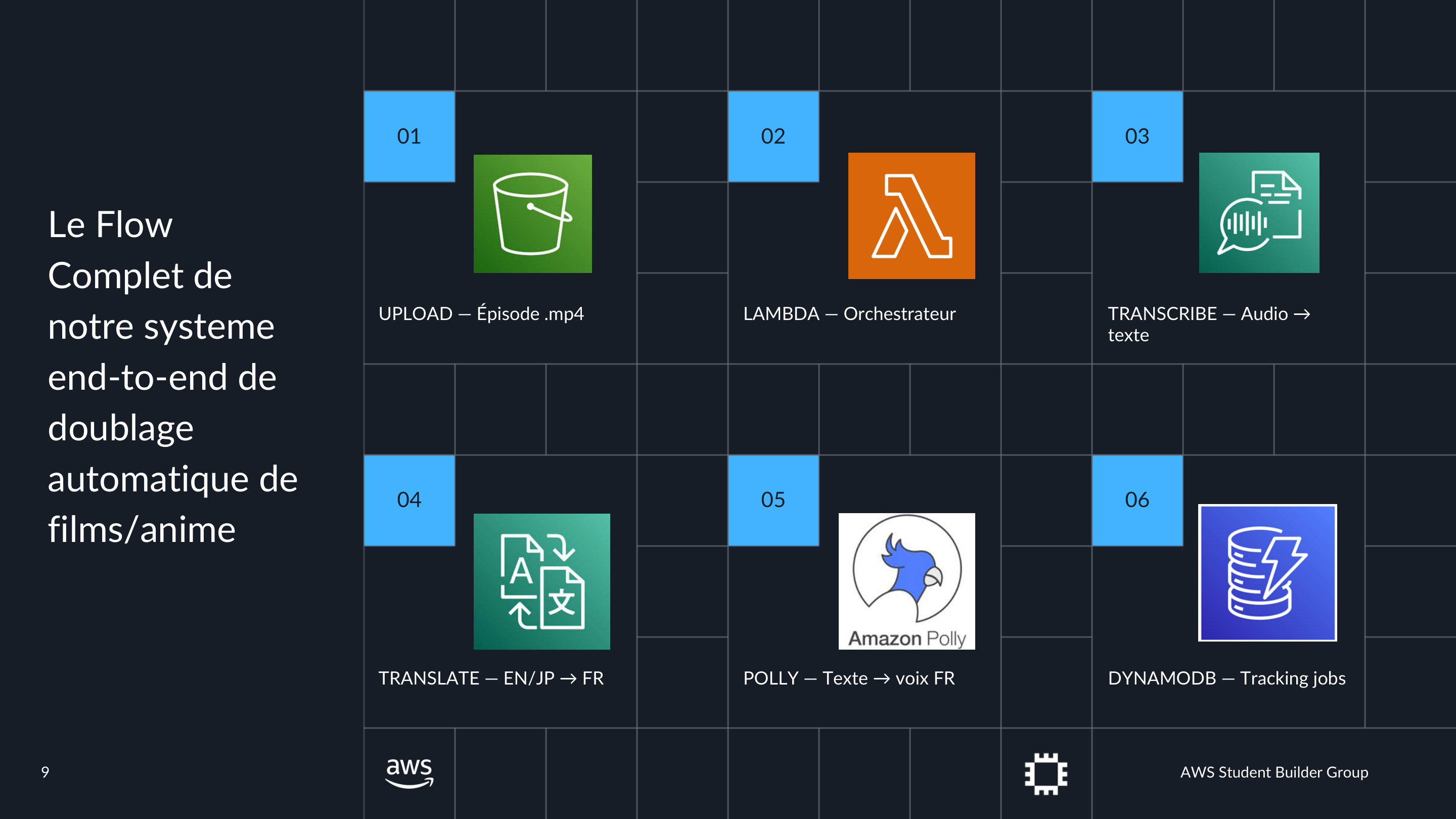
- 01 UPLOAD — Episode .mp4: The raw episode is placed into an Amazon S3 intake bucket (
animefr-episodes). - 02 LAMBDA — Orchestrator: S3 emits an
ObjectCreatedevent that instantaneously invokes our orchestrator AWS Lambda function (animefr-orchestrator). - 03 TRANSCRIBE — Audio → Text: The extracted audio track is ingested by Amazon Transcribe to generate word-level timestamps and speech transcripts.
- 04 TRANSLATE — EN/JP → FR: The text is processed by Amazon Translate (or an LLM fine-tuned for cultural anime terminology) to yield natural dialogue.
- 05 POLLY — Text → Voice: The translated dialogue is synthesized into realistic, emotive speech using Amazon Polly Neural TTS.
- 06 DYNAMODB — Tracking Jobs: Every step, timestamp, and status update is stored in Amazon DynamoDB for frontend polling and real-time progress tracking.
AWS Serverless Architecture: The Deep Dive
Now, let's open the hood and explore the exact cloud architecture powering AniméFR:
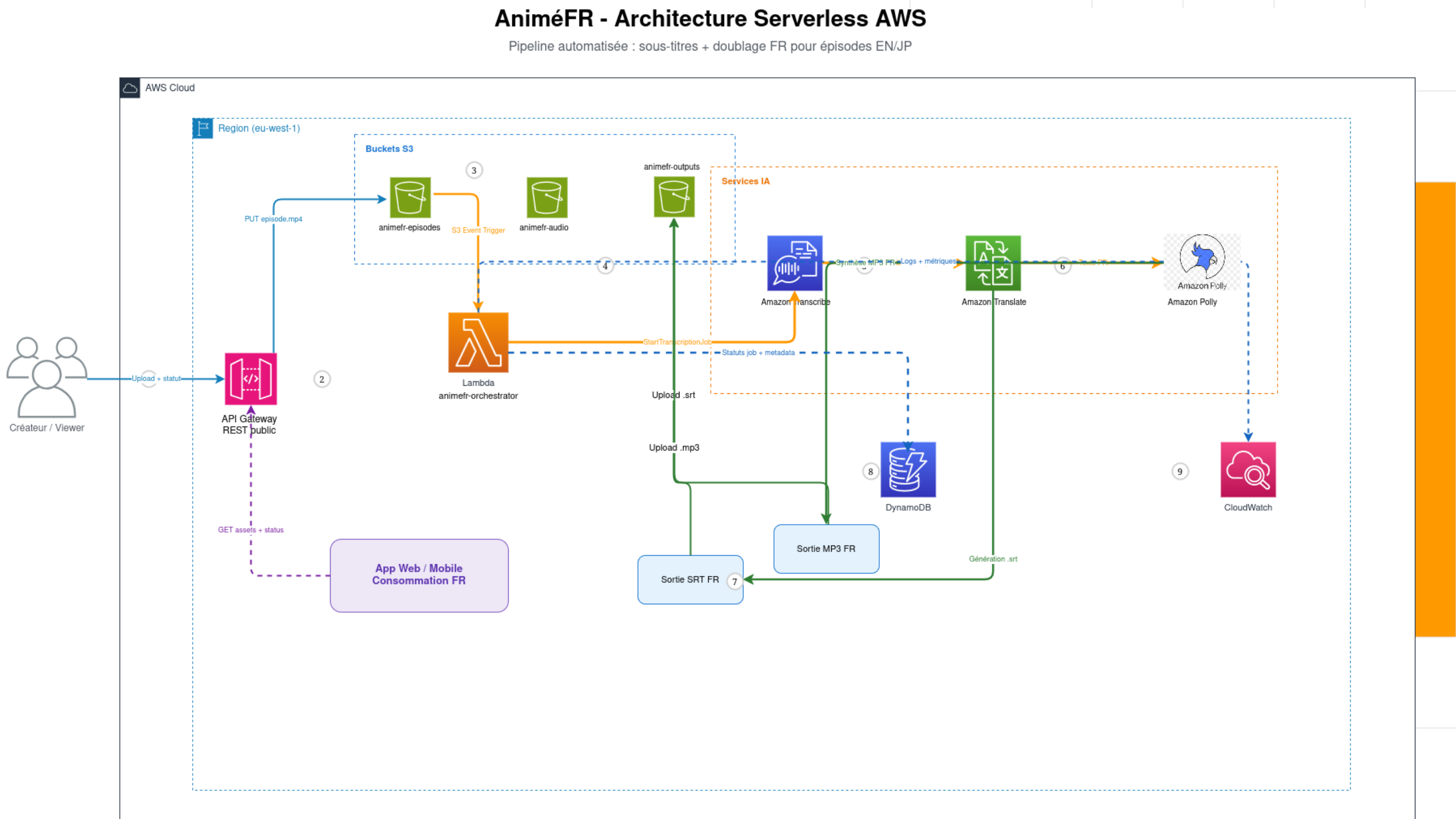
Let's trace the journey of an episode through each AWS building block:
1. Intake & Event Triggering (S3 & API Gateway)
The creator or admin uploads the episode via a REST API Gateway endpoint with presigned S3 URLs. The file lands in animefr-episodes in the eu-west-1 region. The upload triggers an S3 notification that wakes up our orchestrator Lambda in milliseconds.
2. Headless Audio Extraction via FFmpeg Layer
The Lambda function mounts an FFmpeg Lambda Layer. Using a simple command:
ffmpeg -i /tmp/input_episode.mp4 -vn -acodec libmp3lame -ar 16000 -ac 1 /tmp/extracted_audio.mp3The pure audio is decoupled from video frames and saved into a dedicated intermediate bucket: animefr-audio.
3. Speech-to-Text with Precision Timestamps (Amazon Transcribe)
Next, Lambda starts an asynchronous job with Amazon Transcribe:
import boto3

transcribe = boto3.client('transcribe')

response = transcribe.start_transcription_job(
    TranscriptionJobName=f"animefr-{episode_id}",
    LanguageCode="ja-JP", # or en-US depending on source audio
    MediaFormat="mp3",
    Media={'MediaFileUri': f"s3://animefr-audio/{episode_id}.mp3"},
    OutputBucketName="animefr-outputs",
    Subtitles={'Formats': ['srt', 'vtt']} # Native subtitle generation!
)
Amazon Transcribe provides word-level timestamps (start time and end time for each token)[5], allowing us to generate standard .srt files immediately.
4. Semantic Translation (Amazon Translate)
Subtitles are broken down into dialogue lines and passed through Amazon Translate. The engine preserves punctuation and context tags, turning Japanese expressions into colloquial, punchy French dialogue.
5. Neural Voice Synthesis (Amazon Polly)
Once the dialogue is translated and mapped to its original timestamps, it is sent to Amazon Polly using its Neural TTS engine (e.g., the French voices Léa, Mathieu, or Rémi):
polly = boto3.client('polly')

response = polly.synthesize_speech(
    Engine='neural',
    OutputFormat='mp3',
    Text=dialogue_line_french,
    VoiceId='Mathieu' # Engaging male voice
)

with open(f"/tmp/chunk_{index}.mp3", "wb") as f:
    f.write(response['AudioStream'].read())
Polly generates crisp, natural pronunciation with expressive cadence, avoiding the mechanical robotic tone of old-school speech synthesizers.
6. Storage, Tracking & Web/Mobile Delivery
- Outputs: The generated
Sortie SRT FRandSortie MP3 FRare published to theanimefr-outputsbucket. - DynamoDB: Records the status (
PROCESSING→TRANSCRIBED→DUBBED→READY) so users see live progress bars. - CloudWatch: Monitors execution metrics, error rates, and latency.
- Client: The web or mobile app streams the original video with the new audio and subtitle tracks overlayed seamlessly!
Question for you: According to you, what is the most difficult challenge in automated anime dubbing: speech-to-text accuracy against loud background music (OST), natural translation of slang, or matching lip flap timing (lip-sync)?
Key Lessons & The Next Frontier
Building this pipeline taught us several invaluable lessons about the reality of audio AI:
- Background Music & Sound Effects (BGM): In anime, explosive fight scenes and dramatic background music often overpower dialogue. Extracting pristine vocals requires a preprocessing step using source separation models like Demucs or Spleeter to isolate vocals from sound effects.
- Speech Duration Discrepancy: Japanese is a syllabic language with high information density per second. A 3-second Japanese phrase might take 5 seconds to say in French or Ewondo! Solving this requires either dynamic speech rate adjustment (time stretching) or AI-guided script compression[6].
- Emotion & Voice Diversity: Shonen anime features intense screaming, whispering, and crying. While Polly Neural sounds great for narrative dialogue, the next leap forward is integrating zero-shot voice cloning (cloning the original voice timbre while speaking the new target language) with emotion conditioning.
Closing Thoughts: Technology in Service of Culture
When I reflect on this project, the most exciting part isn't just the AWS Lambda triggers, the S3 buckets, or the AI APIs. It's the prospect of democratizing stories.
Anime is a vibrant art form that connects millions of youth around the globe. By using artificial intelligence to bridge linguistic barriers, we are not replacing human voice actors—we are building immediate accessibility bridges for communities and languages that the traditional entertainment industry often overlooks.
Whether it's French, Ewondo, Bassa, or Ghomala: every language deserves to experience the magic of storytelling in real time.
What did you think of this architecture? Have you experimented with automated dubbing, or is there an anime you dream of watching in your mother tongue? Drop your thoughts in the comments below! 🧘♂️✨